
Why NDT Training at Trichy Is a Direct Path to Oil & Gas Careers
Introduction
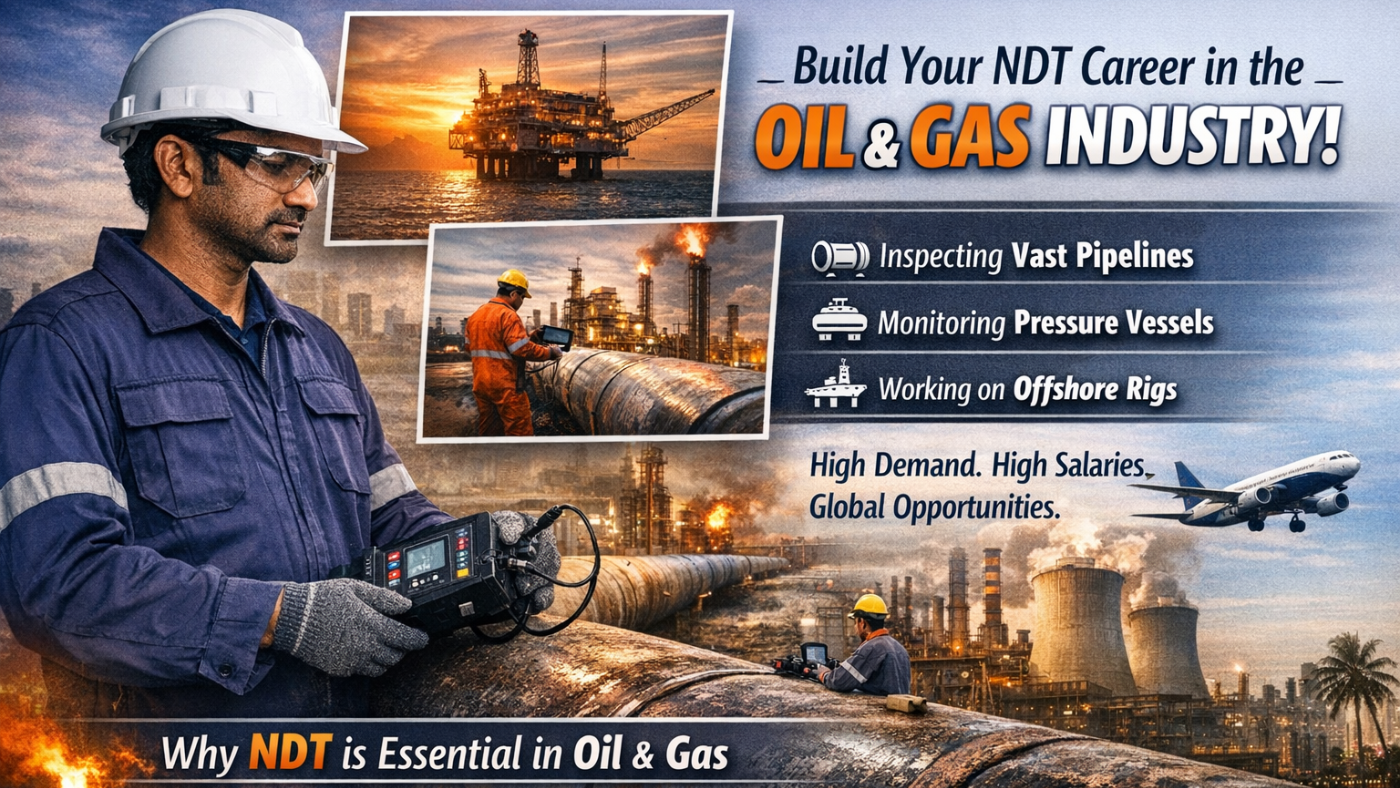
The oil and gas industry is, without exaggeration, the biggest employer of NDT professionals on the planet. Pipelines stretching thousands of kilometres, pressure vessels operating at extreme temperatures, offshore platforms exposed to corrosive saltwater environments, refinery columns that process millions of litres daily — all of these structures demand rigorous, ongoing inspection. And the people who carry out that inspection are, more often than not, NDT technicians holding Level-2 or higher certifications.
If you are looking to build a long-term career in oil and gas, getting your NDT training at Trichy is one of the most direct and practical paths available to you. Here is why — and here is how.
Why the Oil and Gas Industry Runs on NDT
Before you understand why NDT training is so valuable, you need to understand why the oil and gas industry cannot function without it. Every piece of equipment in a refinery, a pipeline, or an offshore platform is under constant physical and chemical stress. Heat cycling causes metal fatigue. Hydrogen sulphide causes sulphide stress corrosion cracking. High-pressure operation creates conditions where even a hairline crack can lead to catastrophic failure.
The financial and human cost of a failure in oil and gas infrastructure is not theoretical — history has documented it. The Bhopal disaster, the Deepwater Horizon explosion, and numerous pipeline ruptures around the world have underscored what happens when inspection protocols fail. In response, the industry has built an extraordinarily rigorous inspection regime. Companies operating in this space are legally and contractually required to maintain certified NDT inspection teams, and the standards they follow — API 510, API 570, ASME, ISO 9712 — are exacting.
This regulatory and operational reality creates a permanent, recession-resistant demand for NDT professionals. Oil and gas companies do not cut NDT budgets when prices fall — they cannot afford to.
What NDT Methods Are Used in Oil and Gas?
The oil and gas sector uses the full spectrum of NDT methods, and your training choices will shape which segment of the industry you can work in. Here is a practical breakdown:
Ultrasonic Testing (UT)
Perhaps the most widely used method in oil and gas, UT is used for thickness measurement of pipelines and pressure vessels to detect internal corrosion, as well as for weld inspection on high-pressure systems. Advanced UT methods like Phased Array UT (PAUT) and Time-of-Flight Diffraction (TOFD) are increasingly in demand for critical applications.
Radiographic Testing (RT)
X-ray and gamma-ray radiography is used for weld inspection, particularly in pipe spooling and construction. While more complex from a safety and logistics standpoint, RT is still a mandated method on many project specifications. Candidates trained in RT are in steady demand.
Magnetic Particle Testing (MT) and Liquid Penetrant Testing (PT)
These are surface inspection methods used widely during fabrication, turnaround maintenance, and field inspection. They are relatively accessible to learn and are typically the starting methods for NDT beginners.
Eddy Current Testing (ET) and Remote Field Inspection (RFI)
These methods are used for heat exchanger tube inspection and other specialised applications. Boon India’s NDT training at Trichy covers ET and RFI, which is not common across all institutes — and that coverage gives graduates an edge in the market.
Certifications That Open Oil and Gas Doors
NDT Level-2 certification through recognised bodies is the baseline requirement for most oil and gas inspection roles. Beyond that, additional certifications significantly boost your career prospects:
API 510 (Pressure Vessel Inspector) and API 570 (Piping Inspector) are two of the most respected credentials in oil and gas inspection. Boon India runs preparatory programs for both of these, which is why many professionals who complete their NDT Level-2 courses at Trichy go on to pursue API certifications through the same institute. Having both NDT Level-2 and an API certification makes you an unusually strong candidate for senior inspection roles.
CSWIP (Certification Scheme for Weld Inspection Personnel) is another credential that pairs well with NDT training, particularly for candidates targeting pipeline and offshore work. The best NDT institute in Trichy offers CSWIP preparatory training as well, making it a one-stop professional development destination.
How Boon India’s NDT Training at Trichy Aligns with Industry Needs
What makes Boon India particularly relevant for oil and gas careers is not just the fact that they offer NDT training — it is how that training is structured. The curriculum is built around international standards and codes: ASNT SNT-TC-1A, ISO 9712, and ASME codes that govern inspection in the process industries. These are the exact standards that oil and gas companies and their EPC contractors cite in job descriptions.
The best NDT trainers at Trichy bring personal field experience into the classroom. When a trainer who has spent years inspecting pipelines in a Gulf refinery explains why a particular defect type is critical or how field conditions affect inspection accuracy, that knowledge lands differently than anything you read in a textbook. It prepares you for real inspection challenges, not just exam scenarios.
The lab setup at Boon India includes equipment and test specimens that mirror what you will encounter on actual project sites. Students leave the best NDT training facility at Trichy knowing how to set up and calibrate their equipment in less-than-ideal field conditions — which is exactly the situation you will face in oil and gas environments.
Career Pathways in Oil and Gas After NDT Training
Once you have your NDT Level-2 certification and a few years of experience, the career trajectory in oil and gas is genuinely exciting. The typical progression looks something like this:
You begin as an NDT Technician on construction or maintenance projects, working under a Level-3 supervisor. After accumulating the required documented hours of inspection experience — typically two to five years, depending on the method and certifying body — you become eligible for Level-3 certification. A Level-3 professional can establish inspection procedures, evaluate results, and take overall technical responsibility for an NDT program.
Beyond Level-3, the career options branch out. Some professionals move into QA/QC management roles, overseeing entire inspection departments. Others specialise further in areas like advanced UT, becoming Phased Array or TOFD specialists. Still others add API certifications and become Senior Inspection Engineers or Asset Integrity Managers — roles that carry significant responsibility and commensurate compensation.
International mobility is a defining feature of oil and gas NDT careers. If you complete your NDT course at Trichy and build a few years of solid experience, the Gulf, Southeast Asia, and West Africa all have active markets for your skills. Many Boon India alumni are currently working in Saudi Arabia, Qatar, UAE, and Kuwait — a testament to the quality of preparation they received.
Practical Advice for Aspiring Oil and Gas NDT Professionals
A few honest recommendations for anyone specifically targeting the oil and gas sector: Start with MT and PT — they are the gateway methods and get you onto project sites quickly. Then pursue UT as your primary specialisation, as it is the most in-demand single method in the sector. Add RT training to broaden your scope. Once you have NDT Level-2 in hand and a year or two of experience, start preparing for API 510 or API 570.
Network actively with the alumni community of your training institute. Boon India has a significant alumni network in the Gulf, and those connections can be the difference between getting your CV noticed and it disappearing into a pile.
Conclusion
Oil and gas is not just a lucrative sector for NDT professionals — it is a sector where skilled, certified technicians are genuinely needed and genuinely valued. NDT training at Trichy, especially through a reputed institute like Boon India, gives you the technical foundation, the international certifications, and the practical readiness to enter this industry with confidence.
If the oil and gas sector is where you want to be, start with the right training. Boon India is at No. 37, Tanish Complex, 3rd Floor, 11th C-Cross, Thillai Nagar, Trichy — 620017. You can reach them on +91 80984 18222 or email info@boonindia.com.
Contact Us
Reach out to them at info@boonindia.com
Call +91 94420 26587 to find out when the next batch begins.
Visit our training centre here
Leave a Reply