Boon India Blog

  • Best NDT Institute in Trichy 2026 — Complete Buyer’s Guide | Boon India

    The Ultimate Guide to Choosing the Best NDT Institute in Trichy (2026)

    By Boon India Editorial Team  |  Published May 2026  |  Updated regularly

    Choosing the right NDT training institute is one of the most consequential decisions you will make in your technical career. Get it right, and you walk out with a certification backed by real practical competence, an internationally recognised standard, and a placement network that opens doors across India and the Gulf. Get it wrong, and you spend money and time on a certificate that employers recognise — but for the wrong reasons.

    This guide is designed to help engineering graduates, diploma holders, and working professionals make that decision with clarity. We cover what to look for when evaluating an NDT institute, what questions to ask before enrolling, and why Boon India has built a reputation as the best NDT institute in Trichy over fifteen years of consistent training outcomes.

    Who is this guide for? • Engineering graduates and diploma holders exploring NDT as a career path• Working professionals in manufacturing, QC, or oil and gas looking to certify• Candidates comparing NDT training options across Trichy and Tamil Nadu• Anyone already enrolled who wants to understand what good training looks like

    What Is NDT Training — and Why Does the Quality of the Institute Matter So Much?

    Non-Destructive Testing is a specialised field. Unlike general engineering courses where knowledge gaps can be papered over with exam performance, NDT is a discipline where the quality of your practical training shows up immediately on the job. When you show up on a pipeline inspection project and cannot calibrate your ultrasonic equipment correctly, or when you misinterpret a radiographic image because your training was rushed, there is no hiding it. The field reveals preparation — or the lack of it.

    This is why the choice of NDT training at Trichy matters so much. Two candidates can hold the same Level-II certification from the same certifying body, but the one who trained at an institute with a well-equipped lab, experienced trainers, and rigorous practical assessment will perform fundamentally differently from the one who studied from photocopied notes in a room with a projector and no actual equipment.

    The certification is the floor, not the ceiling. The quality of your NDT training determines how much above that floor you stand when employers interview you and when project sites test you.

    The 6 Things to Evaluate Before Enrolling in Any NDT Course at Trichy

    Use this checklist when comparing NDT institutes. These are the six criteria that separate genuinely good training from certificates sold as training.

    1. Certification Standard Alignment

    Any NDT course at Trichy worth enrolling in should explicitly state which international certification standard its program follows. The two globally recognised frameworks are ASNT SNT-TC-1A (the American Society for Nondestructive Testing standard) and PCN, which is the certification scheme under ISO 9712. Oil and gas companies, EPC contractors, and inspection agencies in the Gulf specify one or both of these in their hiring requirements.

    Ask the institute directly: ‘Is your NDT Level-2 training aligned with ASNT SNT-TC-1A or ISO 9712?’ If they cannot answer clearly, that tells you what you need to know.

    Boon India’s standard: Curriculum aligned with ASNT SNT-TC-1A and PCN (ISO 9712) across all methods.

    2. The Quality and Background of the Trainers

    The best NDT trainers at Trichy are not academics who have studied NDT — they are professionals who have practised it. Look for trainers who have held inspection roles in oil and gas, power generation, or aerospace before moving into training. Ask specifically about their industry experience, the projects they have worked on, and whether they are themselves certified at Level-III.

    A trainer who has calibrated real UT equipment on a live refinery project explains calibration differently from one who has only done it in a training demonstration. That difference accumulates across fifty hours of instruction and shapes whether you are job-ready or just exam-ready when you leave.

    Boon India’s trainers: Including M. Jeyakandan (Executive Director, 16+ years of field and training experience in API and ASNT disciplines, trainer to professionals in IOCL, BPCL, and across Nigeria, UAE, Saudi Arabia, and Oman).

    3. The Training Facility and Equipment

    NDT is hands-on work. The best NDT training facility at Trichy will have actual NDT instruments — not just demonstration models — that students calibrate and operate during their training hours. It will have real test specimens: weld samples with known defect locations, pipe sections, castings, and heat exchanger tube specimens. These allow students to practise finding real defects under simulated field conditions, not just in controlled demonstrations.

    When you visit an institute (and you should visit before enrolling), ask to see the lab. Ask which instruments are available for student practice during the standard training program. Ask whether the lab is available outside class hours for additional practice.

    Boon India’s facility: The best NDT training facility at Trichy includes industrial-grade UT, RT, MT, PT, ET, and RFI instruments alongside a library of real weld specimens, pipe sections, and tube samples for hands-on practice.

    4. Methods Covered

    A comprehensive NDT Level-2 program covers the six primary methods: Ultrasonic Testing (UT), Radiographic Testing (RT), Magnetic Particle Testing (MT), Liquid Penetrant Testing (PT), Eddy Current Testing (ET), and Remote Field Inspection (RFI). Not all institutes cover all six. Some only offer two or three — which limits your market value as a certified technician.

    RFI in particular is less commonly offered and is specifically in demand for heat exchanger tube inspection in refineries and power plants. An institute that covers RFI as part of their NDT Level-2 courses at Trichy is signalling a curriculum that goes beyond the minimum.

    Boon India covers: All six methods — UT, RT, MT, PT, ET, and RFI — within the NDT Level-2 training program.

    5. The Assessment Process

    International certification standards specify minimum training hours and require both written theory examinations and practical performance assessments. Ask any NDT institute how they handle assessment: is the practical exam conducted on real specimens? Who conducts the assessment? Is it an internal trainer or an independent examiner?

    Rigorous assessment is uncomfortable for students who are not fully prepared — and that discomfort is exactly the point. It means that when you do pass, your certification reflects actual demonstrated competence rather than attendance. Employers know this, and they know which institutes take assessment seriously.

    6. Placement Support and Alumni Network

    A good institute does not end its relationship with students at the certification ceremony. Look for an institute that maintains an active alumni network, has relationships with EPC contractors and inspection agencies, and offers placement assistance as part of the training package. Ask specifically: where are your recent graduates working? Have any been placed in Gulf-based roles?

    An institute that can point you to real alumni in real roles — not just a list of company logos on a website — is one that has delivered on its promises consistently enough to maintain those relationships.

    “The certification is the floor, not the ceiling. The quality of your NDT training determines how much above that floor you stand when employers interview you.”— Boon India — Best NDT Institute in Trichy

    Why Boon India Is the Best NDT Institute in Trichy — The Evidence

    With fifteen years of operation, over 2,000 students trained, and alumni placed across India and the Gulf, Boon India has earned its reputation as the best NDT institute in Trichy through consistent delivery — not marketing claims. Here is the specific evidence behind that reputation:

    ISO 9001:2015 Certification

    Boon India holds ISO 9001:2015 certification — a formally audited quality management standard. This means the institute’s training processes, materials, assessment procedures, and administration have been evaluated by an independent body and found to meet international quality requirements. For candidates applying to international employers, training from an ISO-certified institute is a meaningful signal of credibility.

    Curriculum Aligned with International Standards

    Every NDT Level-2 course at Trichy offered by Boon India is built around ASNT SNT-TC-1A and PCN (ISO 9712) standards. These are not aspirational claims — they are the frameworks that determine minimum training hours, assessment requirements, and certification validity. Boon India’s programs are designed around these standards precisely because graduates need to be competitive for roles specified under them.

    The Best NDT Trainers at Trichy — With Real Industry Experience

    Boon India’s training team includes professionals who have worked in oil and gas inspection, power plant QC, and international project environments before transitioning into full-time training. The best NDT trainers at Trichy are not people who studied NDT and then taught it — they are people who practised it at a high level and now teach from that foundation. The difference in classroom quality is immediately apparent to anyone who has experienced both.

    The Best NDT Training Facility at Trichy

    The Boon India campus at Thillai Nagar, Trichy houses a purpose-built NDT training laboratory with industrial-grade equipment across all six NDT methods, real test specimens including weld samples and tube bundles, and a classroom environment structured around active learning rather than passive instruction. When candidates from other institutes visit, the comparison is usually immediate.

    A Portfolio of Complementary Certifications

    Boon India offers more than just NDT Level-2 training. The institute runs preparatory programs for API 510 (Pressure Vessel Inspector), API 570 (Piping Inspector), ASNT Level-III, and CSWIP (Welding Inspector). This means a professional can build an entire inspection career certification portfolio through a single, trusted institute in Trichy — from the first NDT course all the way to senior API Inspector level.

    NDT Level-2 Courses at Trichy — What the Schedule Looks Like

    Boon India runs regular batches for NDT Level-2 courses at Trichy throughout the year. The training calendar is published on the institute’s website and updated as new batches are confirmed. New batches for UT, RT, MT, PT, ET, and RFI begin regularly, with both full-method programs and multi-method combinations available depending on candidate requirements.

    Candidates who need to complete multiple methods can plan a progression with Boon India’s team — starting with the most in-demand methods (typically UT and MT/PT) and adding additional certifications over time as experience is accumulated.

    Current schedule & enrollment:  
    Visit boonindia.com/calender for the live training calendar and next batch dates. 
    Phone / WhatsApp:  +91 94420 26587  |  +91 80984 18222
    Email:  info@boonindia.com
    Address:  No. 37, Tanish Complex, 3rd Floor, 11th C-Cross, Thillai Nagar, Trichy – 620017

    Making the Decision: A Practical Final Checklist

    Before you sign up for any NDT training at Trichy, run through this checklist one more time:

    1. Visit the institute in person — do not enrol based on brochures or phone calls alone
    2. Ask to see the lab and the actual equipment students use during training
    3. Ask for the trainer’s background — not their title, their actual field experience
    4. Confirm the certification standard (ASNT SNT-TC-1A or ISO 9712)
    5. Ask where recent graduates are currently working
    6. Check whether the institute is ISO certified
    7. Confirm what the practical assessment looks like — real specimens, real conditions
    8. Ask about batch size — smaller batches typically mean more individual attention

    If you visit Boon India and ask every one of these questions, you will leave with clear and specific answers. That is the standard the best NDT institute in Trichy should be held to — and it is the standard Boon India has maintained for fifteen years.

    Conclusion

    The NDT field in India is growing, the international market for Indian NDT professionals remains strong, and the demand for genuinely well-trained, internationally certified technicians continues to outpace supply. The opportunity is real. The question is not whether NDT training at Trichy is worth pursuing — it clearly is. The question is which institute will prepare you to actually seize that opportunity.

    Boon India’s answer to that question is fifteen years of consistent outcomes, more than 2,000 trained professionals, ISO certification, international standard curricula, experienced trainers, and a facility built for real NDT practice. That is the record. The next batch for NDT Level-2 courses at Trichy is forming now.
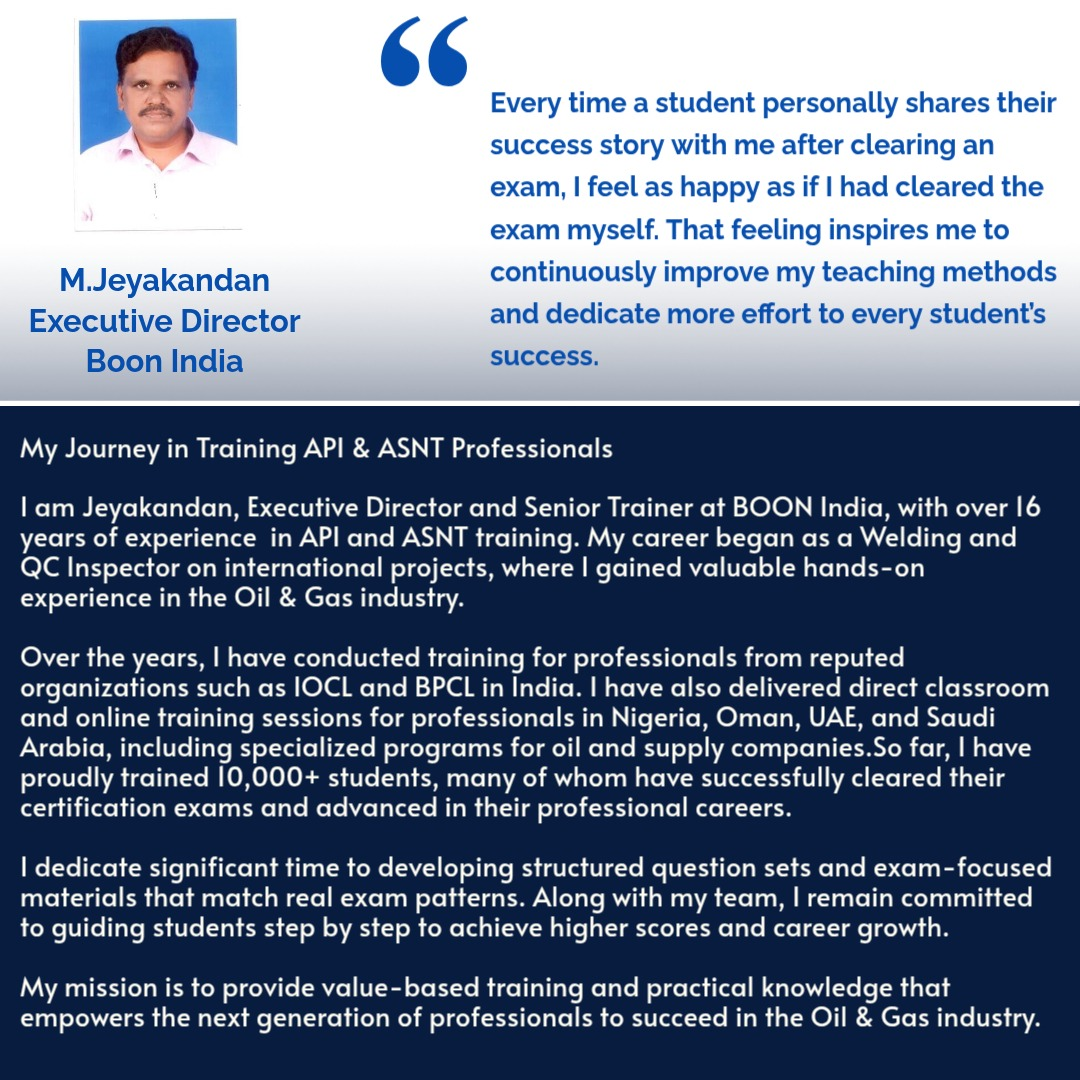

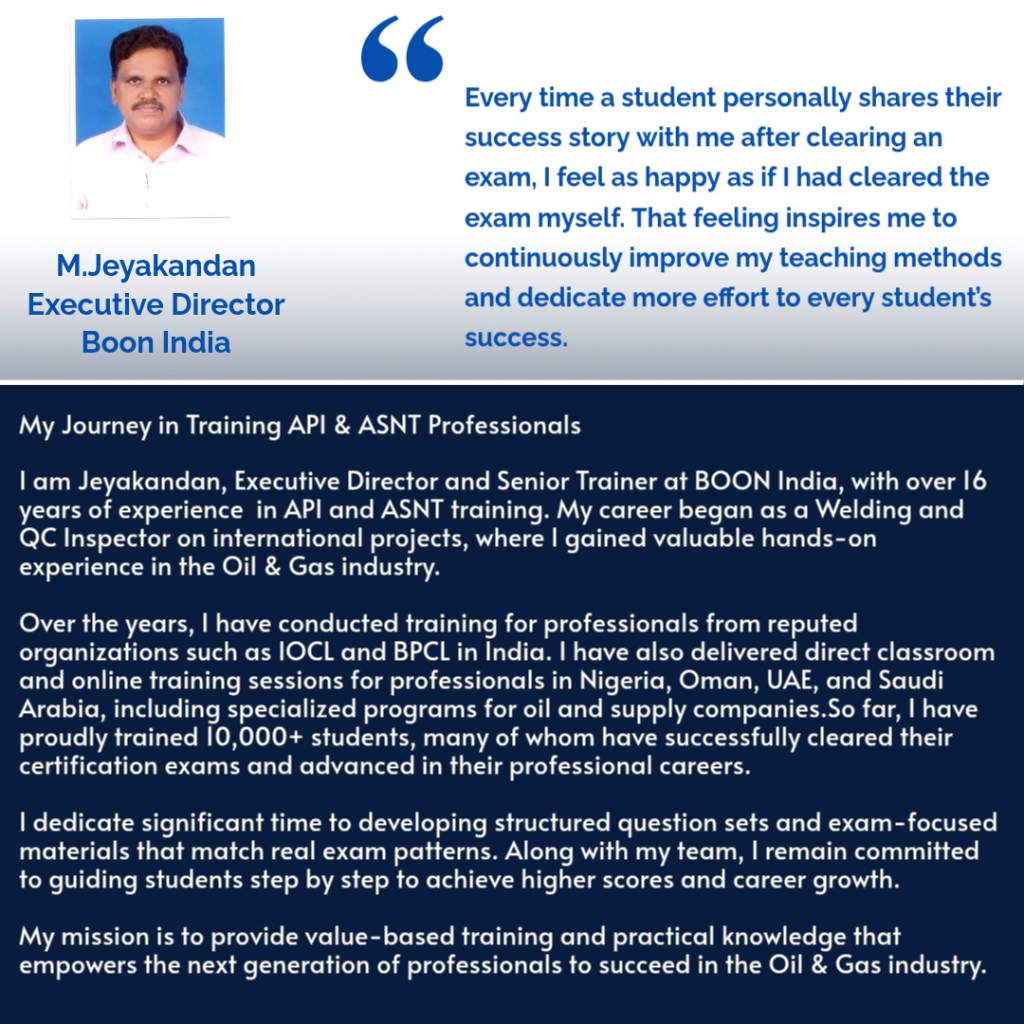
  • Meet the Man Who Has Trained 10,000+ NDT Professionals — M. Jeyakandan, Boon India Trichy

    Meet the Man Who Has Trained 10,000+ NDT Professionals — M. Jeyakandan, Boon India Trichy

    “Every time a student personally shares their success story with me after clearing an exam, I feel as happy as if I had cleared the exam myself. That feeling inspires me to continuously improve my teaching methods and dedicate more effort to every student’s success.”— M. Jeyakandan, Executive Director, Boon India

    Before We Talk About Training, Let Me Tell You Where This Started

    Not many people who teach NDT have actually done NDT — on real pipelines, in real refineries, under real pressure. I have. Before I ever stood in front of a classroom, I was a Welding and Quality Control Inspector working on international projects in the oil and gas industry. I know what it feels like to be the person holding the inspection report that decides whether a pressure vessel is safe to operate. I know what it costs — professionally and personally — to get that call wrong.

    That experience is the foundation of everything I teach at Boon India. It shapes how I explain concepts, which real-world examples I use in class, and how I prepare students for the exams and the field situations that follow. NDT training at Trichy, as we practice it at Boon India, is not about memorising answers. It is about building the kind of deep understanding that keeps people safe and careers intact.

    Sixteen Years — and Over 10,000 Students Later

    When people hear the number 10,000, they sometimes assume it is a marketing figure. It is not. It is the count of real students who have sat through API and ASNT training programs that I have designed, delivered, or overseen since I joined this field as a trainer. Some of them are now working in Saudi Arabia, UAE, Qatar, and Kuwait in senior inspection roles. Some are running their own QC departments in major Indian refineries. A few have gone on to achieve NDT Level-III certification and come back to train others themselves.

    Each one of those 10,000 represents a question I answered in class, a practice paper I marked, a doubt I cleared at 10 pm over the phone because someone had an exam the next morning. That is the kind of engagement I believe NDT training at Trichy should involve. Not a distance between trainer and student, but a genuine investment in each person’s outcome.

    The Industries I Have Trained For — and Why It Matters for You

    One of the things that sets the best NDT trainers at Trichy apart from those who have only ever worked in academia is exposure to multiple industries and operating environments. Over the course of my career, I have conducted training for professionals from organisations including IOCL (Indian Oil Corporation Limited) and BPCL (Bharat Petroleum Corporation Limited) — two of India’s largest refining and distribution companies. These are organisations with exacting standards, and their engineers and inspectors come into training programs with real, specific, practical questions.

    I have also delivered classroom and online training to professionals in Nigeria, Oman, the UAE, and Saudi Arabia — including specialised programs for oil supply companies operating in the Gulf. Training internationally changes your perspective as a trainer. You learn which concepts travel across contexts and which ones need a different kind of explanation depending on the project environment, the applicable codes, and the inspection challenges a technician will actually face on the ground.

    What this breadth of experience means for a student at Boon India is simple: when you ask a question in class, you are not getting a textbook answer. You are getting the answer that comes from having seen that exact issue — or something very close to it — in a real industrial setting.

    How I Approach API and ASNT Training — and Why the Pass Rates Speak for Themselves

    There is a particular challenge in preparing candidates for API 510, API 570, ASNT NDT Level-II, and Level-III examinations. The exams themselves are rigorous — they test not just recall but applied judgement. A candidate who has memorised paragraphs from the codes without understanding the underlying logic will struggle under exam conditions. A candidate who truly understands why each code requirement exists will navigate even an unfamiliar question type with confidence.

    My approach to building that understanding is structured around three things. First, I dedicate significant time to developing question sets and exam-focused materials that match real exam patterns — not generic practice papers, but materials built on detailed analysis of what the actual examinations test and how they test it. If you have been through one of my preparatory programs, you will recognise the style of question before you even sit down in the exam room.

    Second, I believe in step-by-step progression. You do not jump to complex weld discontinuity evaluation before you are completely clear on the fundamental physics of ultrasonic wave propagation. You do not attempt API 570 practice papers before you can read a piping system drawing with confidence. The structure of the program matters as much as the content.

    Third, I remain available. Students who have questions between sessions get answers. Students who are struggling with a particular concept get additional attention. The best NDT institute in Trichy, in my view, is not the one with the most impressive facility — it is the one where a student’s success is treated as the trainer’s personal responsibility.

    “I dedicate significant time to developing structured question sets and exam-focused materials that match real exam patterns. Along with my team, I remain committed to guiding students step by step to achieve higher scores and career growth.”— M. Jeyakandan, Boon India

    What I Have Learned About What Students Actually Need

    Sixteen years of teaching give you a very clear view of the gap between what students think they need and what they actually need to succeed. Most students who come to Boon India for NDT training at Trichy arrive with the idea that they need to know more — more content, more codes, more technical detail. In reality, most of them already have more than enough raw information. What they lack is clarity: a clear mental model of how all the pieces fit together, and confident application of that model under exam and field conditions.

    That is why so much of what we do in class at Boon India is not just information delivery — it is active problem-solving, discussion of real inspection scenarios, and deliberate practice under timed conditions. I want students leaving a session not just with notes but with a changed way of thinking about the subject.

    The students who send me messages after clearing their exams — and they do, regularly — rarely say ‘thank you for the notes’ or ‘the material was comprehensive.’ They say ‘I understood it’ or ‘I felt calm in the exam because I had practised thinking, not just reading.’ That is the goal. That is what NDT training at Trichy should feel like when it is done properly.

    The Mission: Empowering the Next Generation for the Oil & Gas Industry

    The oil and gas industry is not forgiving of mistakes, and it is not forgiving of inadequate preparation. The inspection decisions made by NDT and API professionals have direct consequences for the safety of people working in and around industrial facilities. I take that responsibility seriously — not as a business consideration, but as a professional and personal one.

    My mission, which has not changed since I started training, is to provide value-based training and practical knowledge that genuinely empowers professionals to succeed. That means sending students into the field not just with a certificate but with the competence and confidence to use it. It means building programs that reflect real industrial demands, not just exam syllabi. And it means staying connected to the industry — through my own continued learning, through our trainer network, and through the alumni who come back to share what they are encountering in their careers.

    Boon India, as the best NDT institute in Trichy, carries that mission forward through every batch, every exam season, and every success story that finds its way back to us.

    A Word to Anyone Considering NDT Training at Trichy

    If you are reading this and wondering whether NDT is the right path for you, here is my honest assessment: it is one of the most durable and internationally respected professional qualifications you can build. The demand for certified NDT and API professionals in oil and gas, power generation, aerospace, and infrastructure is not going away. If anything, it is growing — as safety regulations tighten, as infrastructure ages and requires more intensive inspection programs, and as Gulf-based projects continue to recruit heavily from India.

    What I can promise you is this: if you come to Boon India and engage seriously with the program, you will leave better prepared than you came. You will understand the material at a level that serves you not just in the exam room but in every inspection assignment that follows. And if you have questions — before, during, or even after the program — I will be available to answer them.

    That is the commitment Boon India has made to over 10,000 students so far. It is the same commitment we make to every student who walks in.

    Learn More About Our NDT Programs

    Boon India offers NDT Level-II training in UT, RT, MT, PT, ET, and RFI, along with API 510, API 570, ASNT Level-III preparatory, and CSWIP programs. The next batch for NDT Level-2 courses at Trichy begins soon.

  • High-Paying Jobs You Can Get After Completing NDT Level-2 Courses at Trichy

    High-Paying Jobs You Can Get After Completing NDT Level-2 Courses at Trichy

    Lorem Ipsum has been the industry’s standard dummy text ever since the 1500s.

    Introduction

    Let us be honest about something: when you invest time and money into a professional certification, you want to know what it is worth in the job market. Not in vague, feel-good terms — but in real, specific numbers. This post does exactly that. If you have completed or are planning to complete NDT Level-2 courses at Trichy, here is a clear-eyed look at the jobs available to you, the salary ranges attached to them, and the factors that determine where in those ranges you land.

    Why NDT Professionals Tend to Earn More Than Many Engineers

    This might sound counterintuitive, but NDT-certified professionals often out-earn conventional engineering graduates within the first five years of their careers. Here is why: supply and demand. India produces hundreds of thousands of engineering graduates every year, but the number who go on to obtain recognised NDT certifications and accumulate documented field experience is far smaller. The skill is genuinely specialised, and employers pay accordingly.

    Additionally, NDT work is safety-critical. When a company hires an NDT technician to inspect a high-pressure vessel or a welded joint on a gas pipeline, they are entrusting that person with a responsibility that has direct legal and financial consequences if things go wrong. That responsibility level commands a premium over general engineering roles.

    Third, the international mobility of NDT professionals creates a constant pull on domestic salary levels. If Indian companies do not pay competitive rates, qualified NDT professionals simply take their skills to the Gulf or Southeast Asia. This dynamic keeps domestic salaries more competitive than in sectors where international options are limited.

    Salary Breakdown: What NDT Level-2 Professionals Earn in India

    The salary range for NDT Level-2 professionals in India is wide because it depends heavily on the method, the industry, the employer, the region, and individual experience. Here is a realistic breakdown:

    Fresh NDT Level-2 Technician (0–2 years experience)

    Starting salaries in India for freshly certified NDT Level-2 professionals typically fall in the range of INR 3.0 to 5.5 LPA for domestic roles. EPC contractors and large inspection companies tend to pay at the higher end of this range, while smaller fabrication workshops may offer the lower end. Candidates who complete their NDT training at Trichy and have hands-on practical experience from a well-equipped lab are generally more competitive for the higher starting packages.

    Mid-Level NDT Technician / Inspector (3–7 years)

    With three to seven years of documented experience and exposure to multiple NDT methods, professionals in this band typically earn INR 6–12 LPA in India. Those who add API 510 or API 570 certifications to their NDT Level-2 credentials often push into the INR 10–15 LPA range because they qualify for Senior Inspector and QC roles.

    Senior NDT Inspector / Level-3 Candidate (7+ years)

    Senior professionals with Level-2 in multiple methods and strong documentation of their experience are in a strong position to pursue Level-3 certification. Senior inspection engineers in India can earn INR 15–25 LPA with large oil and gas companies, power sector PSUs, or inspection agencies.

    Gulf Salaries: The Numbers That Get People’s Attention

    For most candidates who complete NDT Level-2 courses at Trichy, the Gulf is a significant career option — and the financial case for it is compelling. Here is a realistic snapshot of Gulf salary ranges for NDT professionals:

    NDT Level-2 Technician in Saudi Arabia or Kuwait

    A certified UT or RT technician in a field inspection role with an EPC contractor or operating company typically earns SAR 4,000–8,000 per month (approximately INR 90,000–180,000 per month at current exchange rates). This is usually tax-free and includes accommodation, transportation, and annual return flights. The effective take-home is significantly higher than equivalent gross salary numbers in India.

    QC Inspector / Senior NDT Technician in UAE or Qatar

    Mid-level inspectors with four to eight years of experience and composite certifications (NDT Level-2 plus API or CSWIP) can command AED 8,000–15,000 per month in the UAE (approximately INR 180,000–340,000 per month), with similar benefits packages. At this level, the income difference compared to Indian counterparts is stark.

    Third-Party Inspector in the Gulf

    TPI roles with agencies like Bureau Veritas, TUV SUD, SGS, or Intertek in the Gulf region offer excellent packages — often in the range of USD 3,500–6,000 per month for experienced professionals with recognised certifications. These roles also carry significant professional prestige and autonomy.

    The Highest-Paying NDT Job Roles: A Closer Look

    Not all NDT roles are created equal when it comes to compensation. Here are the specific roles that consistently appear at the top of the pay scale:

    Phased Array UT (PAUT) Specialist

    Advanced UT methods like PAUT and TOFD are increasingly mandated on critical pipeline and pressure vessel inspections. Specialists in these techniques are relatively scarce, and their day rates in the Gulf often exceed those of standard Level-2 technicians by 40–60%. If you are completing NDT Level-2 courses at Trichy, ask specifically about pathways to PAUT training as a next step.

    Rope Access NDT Technician (IRATA Certified)

    Combining NDT Level-2 with IRATA rope access certification opens the door to offshore platform inspection, wind turbine inspection, and complex elevated structure work. The dual certification commands a significant premium — Gulf day rates for experienced rope access NDT technicians can reach USD 300–500 per day.

    Pipeline Integrity Engineer

    A senior technical role focused on assessing the structural health of oil and gas pipelines. This combines NDT expertise with engineering analysis (often using FFS — Fitness-for-Service — methodology). Professionals in this space are well into the six-figure USD salary range in international markets.

    NDT Level-3 / Senior Inspection Engineer

    The top of the technical hierarchy, Level-3 professionals in the oil and gas or power sector can earn INR 20–30 LPA in India or USD 6,000–10,000 per month in Gulf corporate or consulting roles. Getting here takes years of deliberate experience accumulation, but it is a reachable goal for disciplined professionals.

    How the Right Training Partner Affects Your Starting Salary

    Salary outcomes are not just about certification — they are also about the quality of your training and how well you can demonstrate practical competence to employers. This is where your choice of training institute matters more than many candidates realise.

    The best NDT trainers at Trichy — including those at Boon India — prepare students not just for the written examination but for real field conditions. When a hiring manager interviews two candidates with the same Level-2 certificate and one can speak knowledgeably about calibration challenges, code requirements, and defect evaluation criteria while the other struggles with basic practical questions, the salary offer will differ.

    Boon India’s practical lab at the best NDT training facility at Trichy is equipped with industrial-grade NDT equipment and actual test specimens. Graduates leave with hands that have calibrated real equipment and eyes that have evaluated real defects — not just diagrams. That practical readiness shows up in interviews and in early performance reviews, and it translates to faster salary progression.

    Making the Most of Your NDT Level-2 Certification Financially

    A few strategic recommendations for maximising your earnings after NDT Level-2 courses at Trichy:

    Pursue certification in multiple methods early. A candidate with Level-2 in both UT and RT, or in both MT and PT, is more versatile and more attractive to employers than a single-method specialist at the entry level. Boon India’s schedule covers multiple NDT methods, and combining them early in your career is smart planning.

    Start your Gulf job search earlier than you think you need to. Many Gulf-based roles require at least two years of documented field experience — start building and documenting that experience from day one. Keep records of every inspection you carry out, every piece of equipment you use, and every code you work to.

    Invest in complementary certifications as soon as you have the eligibility. API 510 or API 570, combined with your NDT Level-2, creates a certification profile that puts you in the Senior Inspector salary band rather than the Technician band. Boon India offers API preparatory programs and ASNT Level-III preparatory training, making it easy to plan your certification progression through a single trusted institute.

    Conclusion

    The financial rewards of an NDT career are real and substantial — but they are not automatic. They come from making smart training choices, accumulating the right experience, and continuing to invest in your certification profile over time. Completing NDT Level-2 courses at Trichy through Boon India gives you a strong foundation, aligned with international standards and backed by practical training that shows up in the real world.

    The best NDT institute in Trichy has produced over 1,000 NDT technicians and counting. The question is whether you will be part of the next cohort. The next batch begins soon — reach out to Boon India at +91 94420 26587 or visit boonindia.com to secure your place.

    Contact Us

    Reach out to them at info@boonindia.com

    Call +91 94420 26587 to find out when the next batch begins.

    Visit our training centre here

  • Career Growth Paths After Completing an NDT Course at Trichy

    Career Growth Paths After Completing an NDT Course at Trichy

    Lorem Ipsum has been the industry’s standard dummy text ever since the 1500s.

    Introduction

    Too many people treat NDT certification as a destination. It is not. It is a starting point — and understanding what lies beyond that starting point is what separates technicians who build genuinely satisfying careers from those who stagnate in the same role for a decade. If you have recently completed or are about to complete an NDT course at Trichy, this post will walk you through the full landscape of where your career can go and how to get there deliberately.

    The NDT Career Ladder: Understanding the Levels

    The NDT professional structure is built around three levels of certification, defined by international standards bodies like ASNT and ISO 9712. Understanding what each level means in practice is essential for planning your career arc.

    Level I — The Starting Point

    A Level-I technician carries out specific calibration and testing tasks under the direct supervision of a Level-II or Level-III professional. They follow written instructions and do not make independent judgements about accepting or rejecting test results. This is the entry level, and most fresh candidates begin here unless they have sufficient prior experience and training to qualify directly for Level-II.

    Level II — The Working Professional

    This is the certification most employers are actually hiring for. A Level-II professional conducts tests, interprets results, and prepares inspection reports. The NDT Level-2 courses at Trichy that Boon India offers are targeted squarely at this level — and this is where your career genuinely begins. Most oil and gas field inspection roles, QC positions, and third-party inspection roles are Level-II jobs.

    Level III — The Technical Expert

    Level-III is the pinnacle of the NDT certification hierarchy. A Level-III professional is responsible for establishing techniques and procedures, interpreting codes and standards, approving written procedures, and providing technical direction to Level-I and Level-II personnel. This certification requires extensive documented experience (typically five or more years at Level-II) and passing rigorous examinations. Level-III professionals often move into management, consulting, or corporate quality roles.

    From Technician to Inspector: Building Your First Five Years

    The first five years after completing your NDT course at Trichy are the foundation on which everything else is built. The most important currency during this period is documented inspection hours — the formal record of your field experience that you will submit when applying for Level-III or when applying for roles with internationally operating companies.

    Focus on accumulating experience in the methods you are certified in. If you started with MT and PT, aim to add UT to your profile within the first two years — it is the method with the broadest international demand. Keep detailed personal records of the types of inspections you carry out, the industries you work in, the codes you apply, and the equipment you use.

    During this phase, seek out assignments that expose you to different industries and different operating conditions. A technician who has inspected welds on both onshore pipelines and offshore platforms, who has worked in both new construction and plant turnaround environments, is far more valuable than one who has done the same type of inspection in the same plant for five years.

    Specialisation: The Routes That Pay Best

    Around the three to five year mark, many NDT professionals face a choice: continue as a generalist and build broad experience, or specialise in an advanced technique and build deep expertise. Both paths have merit, but specialisation generally commands higher compensation. Here are the specialisations worth targeting:

    Phased Array Ultrasonic Testing (PAUT) and TOFD

    These are advanced UT methods that provide faster, more accurate results than conventional UT for many applications. Companies operating under modern pipeline codes and pressure vessel standards increasingly specify PAUT and TOFD. Specialists in these techniques are in genuinely short supply relative to demand, and their day rates reflect that.

    Asset Integrity and Fitness-for-Service Assessment

    This is a management-level specialisation that combines NDT data with engineering judgement to assess whether a structure can continue to operate safely. Professionals in this area — sometimes called Inspection Engineers or Integrity Engineers — are some of the highest earners in the inspection world.

    Rope Access NDT

    Combining NDT skills with rope access certification (IRATA Level 1–3) opens doors to offshore platform inspection, wind turbine inspection, and complex industrial structure inspection. It is physically demanding but financially rewarding, with Gulf-based rope access NDT technicians earning well above standard Level-II rates.

    Adding Complementary Certifications: The Smart Strategy

    A smart NDT professional does not rely on a single certification. The best NDT trainers at Trichy — particularly at Boon India — consistently advise their graduates to build a complementary certification portfolio over time. Here is a proven combination:

    Start with NDT Level-2 in UT and MT/PT. Then add API 510 (Pressure Vessel Inspector) or API 570 (Piping Inspector) — both of which Boon India offers preparatory courses for. Then consider CSWIP 3.1 Welding Inspector, which pairs powerfully with NDT in quality control and oil and gas roles. With this combination, you transition from NDT Technician to QC Inspector to Senior Inspection Engineer — a career arc that can take you from INR 4 LPA to INR 20 LPA or more within ten years, or to Gulf packages of USD 3,000–6,000 per month.

    International Career Opportunities: The Real Picture

    The international dimension of NDT careers is significant enough to deserve honest attention. The Gulf Cooperation Council (GCC) countries — Saudi Arabia, UAE, Qatar, Kuwait, Oman, and Bahrain — collectively host some of the world’s largest oil and gas infrastructure. These countries do not have a domestic workforce large enough to fill all inspection roles, and they actively recruit from India, particularly from experienced NDT professionals.

    Candidates who complete their NDT course at Trichy through Boon India benefit from a curriculum aligned with international standards, giving them the technical credibility that Gulf-based recruiters look for. The best NDT institute in Trichy has alumni placed across the Gulf, and their practical training approach — emphasising real field scenarios — means graduates can hit the ground running on international projects.

    Southeast Asia (Malaysia, Indonesia, Singapore) is another strong market for NDT professionals, particularly in the petrochemical and offshore sectors. Australia’s oil and gas and mining sectors also hire Indian NDT professionals. The key to accessing these markets is strong certification credentials, documented experience, and — increasingly — proficiency in advanced techniques like PAUT.

    Moving into Management and Consulting

    At the senior end of the NDT career spectrum, the options become genuinely broad. Level-III certified professionals with strong industry track records often move into:

    NDT Department Management — leading an inspection team within a large industrial company or contractor. This involves not just technical oversight but also budgeting, scheduling, personnel management, and client interaction. It is a management role with technical depth, which is a rare and valuable combination.

    Independent Consulting — providing NDT expertise to multiple clients on a project-by-project basis. This requires a strong reputation, deep technical knowledge, and a solid network. But the financial upside — and the autonomy — can be significant for the right person.

    Training and Education — sharing knowledge by becoming a trainer or examiner. Boon India itself employs trainers who came through the industry and now pass on their expertise to the next generation. This is a path for those who find teaching rewarding and want to have a lasting impact on the profession.

    Conclusion

    An NDT course at Trichy is not just a short-term career move. It is the beginning of a professional journey that, navigated well, can take you from field technician to senior engineer to manager or consultant — in India and internationally. The career growth paths are real, the compensation is competitive, and the demand for skilled NDT professionals shows no sign of weakening.

    Boon India at Trichy has been the launchpad for hundreds of these careers. Their ongoing schedule of NDT Level-2 courses, API preparatory programs, and CSWIP training makes them the natural partner for every stage of your professional development. Connect with them today and start mapping your own growth path.

    Contact Us

    Reach out to them at info@boonindia.com

    Call +91 94420 26587 to find out when the next batch begins.

    Visit our training centre here

  • How NDT Training at Trichy Can Help You Build a Career in the Oil & Gas Industry

    How NDT Training at Trichy Can Help You Build a Career in the Oil & Gas Industry

    Lorem Ipsum has been the industry’s standard dummy text ever since the 1500s.

    Introduction

    The oil and gas industry is, without exaggeration, the biggest employer of NDT professionals on the planet. Pipelines stretching thousands of kilometres, pressure vessels operating at extreme temperatures, offshore platforms exposed to corrosive saltwater environments, refinery columns that process millions of litres daily — all of these structures demand rigorous, ongoing inspection. And the people who carry out that inspection are, more often than not, NDT technicians holding Level-2 or higher certifications.

    If you are looking to build a long-term career in oil and gas, getting your NDT training at Trichy is one of the most direct and practical paths available to you. Here is why — and here is how.

    Why the Oil and Gas Industry Runs on NDT

    Before you understand why NDT training is so valuable, you need to understand why the oil and gas industry cannot function without it. Every piece of equipment in a refinery, a pipeline, or an offshore platform is under constant physical and chemical stress. Heat cycling causes metal fatigue. Hydrogen sulphide causes sulphide stress corrosion cracking. High-pressure operation creates conditions where even a hairline crack can lead to catastrophic failure.

    The financial and human cost of a failure in oil and gas infrastructure is not theoretical — history has documented it. The Bhopal disaster, the Deepwater Horizon explosion, and numerous pipeline ruptures around the world have underscored what happens when inspection protocols fail. In response, the industry has built an extraordinarily rigorous inspection regime. Companies operating in this space are legally and contractually required to maintain certified NDT inspection teams, and the standards they follow — API 510, API 570, ASME, ISO 9712 — are exacting.

    This regulatory and operational reality creates a permanent, recession-resistant demand for NDT professionals. Oil and gas companies do not cut NDT budgets when prices fall — they cannot afford to.

    What NDT Methods Are Used in Oil and Gas?

    The oil and gas sector uses the full spectrum of NDT methods, and your training choices will shape which segment of the industry you can work in. Here is a practical breakdown:

    Ultrasonic Testing (UT)

    Perhaps the most widely used method in oil and gas, UT is used for thickness measurement of pipelines and pressure vessels to detect internal corrosion, as well as for weld inspection on high-pressure systems. Advanced UT methods like Phased Array UT (PAUT) and Time-of-Flight Diffraction (TOFD) are increasingly in demand for critical applications.

    Radiographic Testing (RT)

    X-ray and gamma-ray radiography is used for weld inspection, particularly in pipe spooling and construction. While more complex from a safety and logistics standpoint, RT is still a mandated method on many project specifications. Candidates trained in RT are in steady demand.

    Magnetic Particle Testing (MT) and Liquid Penetrant Testing (PT)

    These are surface inspection methods used widely during fabrication, turnaround maintenance, and field inspection. They are relatively accessible to learn and are typically the starting methods for NDT beginners.

    Eddy Current Testing (ET) and Remote Field Inspection (RFI)

    These methods are used for heat exchanger tube inspection and other specialised applications. Boon India’s NDT training at Trichy covers ET and RFI, which is not common across all institutes — and that coverage gives graduates an edge in the market.

    Certifications That Open Oil and Gas Doors

    NDT Level-2 certification through recognised bodies is the baseline requirement for most oil and gas inspection roles. Beyond that, additional certifications significantly boost your career prospects:

    API 510 (Pressure Vessel Inspector) and API 570 (Piping Inspector) are two of the most respected credentials in oil and gas inspection. Boon India runs preparatory programs for both of these, which is why many professionals who complete their NDT Level-2 courses at Trichy go on to pursue API certifications through the same institute. Having both NDT Level-2 and an API certification makes you an unusually strong candidate for senior inspection roles.

    CSWIP (Certification Scheme for Weld Inspection Personnel) is another credential that pairs well with NDT training, particularly for candidates targeting pipeline and offshore work. The best NDT institute in Trichy offers CSWIP preparatory training as well, making it a one-stop professional development destination.

    How Boon India’s NDT Training at Trichy Aligns with Industry Needs

    What makes Boon India particularly relevant for oil and gas careers is not just the fact that they offer NDT training — it is how that training is structured. The curriculum is built around international standards and codes: ASNT SNT-TC-1A, ISO 9712, and ASME codes that govern inspection in the process industries. These are the exact standards that oil and gas companies and their EPC contractors cite in job descriptions.

    The best NDT trainers at Trichy bring personal field experience into the classroom. When a trainer who has spent years inspecting pipelines in a Gulf refinery explains why a particular defect type is critical or how field conditions affect inspection accuracy, that knowledge lands differently than anything you read in a textbook. It prepares you for real inspection challenges, not just exam scenarios.

    The lab setup at Boon India includes equipment and test specimens that mirror what you will encounter on actual project sites. Students leave the best NDT training facility at Trichy knowing how to set up and calibrate their equipment in less-than-ideal field conditions — which is exactly the situation you will face in oil and gas environments.

    Career Pathways in Oil and Gas After NDT Training

    Once you have your NDT Level-2 certification and a few years of experience, the career trajectory in oil and gas is genuinely exciting. The typical progression looks something like this:

    You begin as an NDT Technician on construction or maintenance projects, working under a Level-3 supervisor. After accumulating the required documented hours of inspection experience — typically two to five years, depending on the method and certifying body — you become eligible for Level-3 certification. A Level-3 professional can establish inspection procedures, evaluate results, and take overall technical responsibility for an NDT program.

    Beyond Level-3, the career options branch out. Some professionals move into QA/QC management roles, overseeing entire inspection departments. Others specialise further in areas like advanced UT, becoming Phased Array or TOFD specialists. Still others add API certifications and become Senior Inspection Engineers or Asset Integrity Managers — roles that carry significant responsibility and commensurate compensation.

    International mobility is a defining feature of oil and gas NDT careers. If you complete your NDT course at Trichy and build a few years of solid experience, the Gulf, Southeast Asia, and West Africa all have active markets for your skills. Many Boon India alumni are currently working in Saudi Arabia, Qatar, UAE, and Kuwait — a testament to the quality of preparation they received.

    Practical Advice for Aspiring Oil and Gas NDT Professionals

    A few honest recommendations for anyone specifically targeting the oil and gas sector: Start with MT and PT — they are the gateway methods and get you onto project sites quickly. Then pursue UT as your primary specialisation, as it is the most in-demand single method in the sector. Add RT training to broaden your scope. Once you have NDT Level-2 in hand and a year or two of experience, start preparing for API 510 or API 570.

    Network actively with the alumni community of your training institute. Boon India has a significant alumni network in the Gulf, and those connections can be the difference between getting your CV noticed and it disappearing into a pile.

    Conclusion

    Oil and gas is not just a lucrative sector for NDT professionals — it is a sector where skilled, certified technicians are genuinely needed and genuinely valued. NDT training at Trichy, especially through a reputed institute like Boon India, gives you the technical foundation, the international certifications, and the practical readiness to enter this industry with confidence.

    If the oil and gas sector is where you want to be, start with the right training. Boon India is at No. 37, Tanish Complex, 3rd Floor, 11th C-Cross, Thillai Nagar, Trichy — 620017. You can reach them on +91 80984 18222 or email info@boonindia.com.

    Contact Us

    Reach out to them at info@boonindia.com

    Call +91 94420 26587 to find out when the next batch begins.

    Visit our training centre here

  • Top Career Opportunities After Completing NDT Level-2 Courses at Trichy

    Top Career Opportunities After Completing NDT Level-2 Courses at Trichy

    Introduction

    Finishing your NDT Level-2 certification is one thing. Knowing what to do with it is another conversation entirely — and it is one worth having in detail. A lot of candidates complete their NDT Level-2 courses at Trichy with a general sense that ‘good jobs are available,’ but without a clear map of exactly which roles are open to them, in which industries, and what those roles actually pay. This post gives you that map.

    First, What Does NDT Level-2 Actually Certify You to Do?

    Before diving into job roles, it is worth being precise about what Level-2 certification means. An NDT Level-2 technician is qualified to set up and calibrate testing equipment, conduct tests according to specific codes and standards, interpret and evaluate test results, and prepare written instructions and reports. They work under the supervision of a Level-3 professional on complex issues but are largely autonomous in their day-to-day inspection work.

    This is a working certification — it puts you on the shop floor, in the field, and at inspection sites. It is the certification that most hiring managers look for when they are filling inspection roles. And if you have completed your NDT Level-2 courses at Trichy through a recognised institute like Boon India, you come with training that aligns with ASNT SNT-TC-1A and PCN (ISO 9712) standards — the international benchmarks that multinational employers actually care about.

    Industries Actively Hiring NDT Level-2 Professionals

    The breadth of industries that employ NDT professionals is one of the most underappreciated aspects of this career. Here is a realistic rundown of where your certification will open doors:

    Oil and Gas

    This is the single largest employer of NDT professionals globally. Upstream exploration, midstream pipeline networks, and downstream refining all require constant inspection. Corrosion under insulation, weld integrity, pressure vessel condition — NDT technicians are on every major oil and gas project. Companies like ONGC, BPCL, Reliance Industries, and their EPC contractors hire NDT Level-2 professionals regularly in India, and Gulf-based companies — Saudi Aramco, ADNOC, KOC, KNPC — recruit heavily from trained Indian NDT professionals.

    Power Generation

    Nuclear power plants, thermal plants, and the growing renewable energy sector all have structural components that need regular inspection. Turbine blades, boiler tubes, pressure piping — these components cannot fail. NDT is the primary tool for ensuring they do not. NTPC, NLC, and state electricity boards in India maintain active NDT departments.

    Aerospace and Defence

    Aircraft structures, engine components, and composite materials require the highest precision of NDT inspection available. Indian defence organisations (HAL, DRDO, IAF maintenance units) and civil aviation MRO (Maintenance, Repair and Overhaul) facilities hire certified NDT technicians for roles that are both prestigious and exceptionally well-paying.

    Infrastructure and Construction

    Bridges, high-rise structures, dams, and industrial foundations require periodic structural health monitoring. As India accelerates infrastructure spending, the demand for NDT professionals in construction quality control is increasing steadily.

    Shipbuilding and Marine

    Ports like Chennai, Kochi, Visakhapatnam, and Mangaluru host shipyards and repair facilities that rely on NDT for hull inspection, weld quality, and corrosion mapping. Cochin Shipyard and Mazagon Dock are notable employers.

    Specific Job Roles You Can Target After NDT Level-2 Courses at Trichy

    Your Level-2 certification from the best NDT institute in Trichy opens the door to several distinct job titles:

    NDT Technician

    The entry-level field role where you carry out inspections under the methodology you are certified in — UT, RT, MT, PT, ET, or RFI. In large organisations, technicians are deployed on project sites and rotate between assignments. Starting salaries in India range from INR 3–5 LPA, while Gulf-based roles start at USD 1,200–2,000 per month, often with accommodation and transport included.

    Quality Control Inspector

    A step above the pure technician role, QC Inspectors are responsible for ensuring that manufacturing or construction processes meet specified quality standards. NDT is a key part of this role, combined with dimensional checks, material certification verification, and documentation. This role exists heavily in EPC contracting companies.

    Welding Inspector (with additional CSWIP or AWS/CWI certification)

    Many NDT Level-2 professionals add welding inspection qualifications to their profile. Boon India also offers CSWIP preparatory programs, which is a natural progression. Welding Inspectors are among the highest-paid inspection professionals, especially in offshore and oil and gas environments.

    Pipeline Inspection Engineer

    Specialising in midstream and upstream pipeline integrity, this role focuses on UT, RT, and corrosion mapping of pipelines. It is a highly in-demand specialisation for candidates with NDT Training at Trichy who want to work in the oil and gas sector.

    Third-Party Inspector (TPI)

    TPI roles are offered by inspection companies like Bureau Veritas, TUV SUD, SGS, Lloyd’s Register, and DNV. These inspectors work independently of both the manufacturer and the client, providing impartial quality assurance. The role is well-paying, internationally mobile, and professionally stimulating.

    How Boon India’s NDT Level-2 Training Prepares You for These Roles

    One of the things that sets NDT training at Trichy’s Boon India apart is the emphasis on practical, field-ready skills. The best NDT trainers at Trichy — many of whom have direct industry experience in oil and gas inspection, power plant maintenance, or aerospace QC — bring real scenarios into the training room. Students practice on actual weld specimens, calibrate real equipment, and learn to write inspection reports that match what employers actually ask for.

    Boon India has trained over 1,000 NDT technicians and has an established track record of placement support. Their connections with EPC companies, third-party inspection agencies, and Gulf-based recruiters are a genuine advantage for graduates. When you finish your NDT Level-2 courses at Trichy through Boon India, you are not walking out with just a certificate — you are walking out with a professional network.

    International Placements: The Gulf Factor

    It would be incomplete to discuss NDT career opportunities without talking honestly about the Gulf. Saudi Arabia, the UAE, Qatar, Kuwait, and Oman collectively have tens of thousands of NDT inspection jobs at any given time, and they actively recruit certified professionals from India. The packages are significantly better than domestic roles — a Level-2 UT technician in Saudi Arabia, for example, can expect SAR 5,000–8,000 per month, tax-free, with accommodation and flights covered.

    Boon India’s curriculum is designed with international standards in mind, which means their graduates are competitive for these positions. Several alumni are currently placed with companies in the Gulf, serving as living proof that the best NDT training facility at Trichy is not just talk.

    Conclusion

    The career landscape after completing NDT Level-2 courses at Trichy is genuinely wide and genuinely rewarding. From oil and gas to aerospace, from domestic inspection jobs to Gulf placements, the opportunities are real and the demand is consistent. The key is choosing the right training partner — one that prepares you for the real world, not just the examination room. Boon India has been doing exactly that since 2009. The next batch is forming soon. Do not let it fill up without you.

    Contact Us

    Reach out to them at info@boonindia.com

    Call +91 94420 26587 to find out when the next batch begins.

    Visit our training centre here

  • Why NDT Training at Trichy Is Becoming a Popular Career Choice for Engineering Graduates

    Lorem Ipsum has been the industry’s standard dummy text ever since the 1500s.

    Introduction

    If you had asked a freshly minted engineering graduate ten years ago what their career plan was, the answer almost always circled back to IT, core manufacturing, or a government job. But something has quietly shifted over the last few years. More and more graduates — especially those from mechanical, civil, and metallurgical backgrounds — are turning toward Non-Destructive Testing (NDT), and Trichy has become one of the most talked-about destinations for this kind of training. If you are wondering why, this post breaks it all down in plain language.

    What Exactly Is NDT and Why Should You Care?

    Non-Destructive Testing is, at its core, the science of examining materials, components, and structures without damaging them. Think of it this way: a bridge, a refinery pipeline, an aircraft fuselage, or a pressure vessel — all of these need to be inspected regularly to make sure they are safe. You cannot simply cut them open or stress-test them until something breaks. Instead, NDT technicians use techniques like Ultrasonic Testing (UT), Radiographic Testing (RT), Magnetic Particle Testing (MT), Liquid Penetrant Testing (PT), and Eddy Current Testing (ET) to detect flaws, cracks, or weaknesses that the naked eye would never catch.

    The global NDT market was valued at over USD 12 billion in 2023 and is projected to grow steadily through the decade. Industries like oil and gas, aerospace, power generation, shipbuilding, and construction all depend heavily on NDT professionals. In India alone, the demand for certified NDT technicians has been rising sharply as infrastructure projects multiply and safety regulations tighten. That is precisely why an NDT course at Trichy is no longer just an alternative career path — it is increasingly a smart primary choice.

    Why Trichy? The City’s Growing Role in NDT Education

    Tiruchirappalli, or Trichy as everyone calls it, has long been known as an industrial and educational hub in Tamil Nadu. The city is home to BHEL (Bharat Heavy Electricals Limited), one of India’s largest public sector engineering enterprises, along with a thriving ecosystem of fabrication workshops, foundries, and engineering firms. The proximity to major refineries in Nagapattinam and industrial corridors connecting Chennai and Coimbatore makes Trichy a natural gateway for NDT careers.

    But beyond geography, Trichy has developed genuine expertise in NDT education. Institutes like Boon India — formally known as the Boon Institute of Specialized Training and Consultancy Services — have been running NDT Level-II training and certification programs since 2009. That is over fifteen years of curriculum refinement, industry connections, and trainer expertise. When candidates search for the best NDT institute in Trichy, Boon India’s name comes up consistently — and there’s a reason for that reputation.

    The city’s training infrastructure also benefits from lower living costs compared to metros, which means out-of-town students can train here without burning through their savings. Hostels, shared accommodations, and affordable dining options make Trichy a practical choice for candidates from across Tamil Nadu, Kerala, Andhra Pradesh, and beyond.

    Reasons Engineering Graduates Are Specifically Choosing NDT Training

    Engineering graduates face a paradox today. India produces over 1.5 million engineers every year, but the job market for conventional roles has not kept pace. Core engineering jobs in manufacturing and design are fiercely competitive, and IT-sector roles have seen hiring slowdowns. NDT offers a way out of this gridlock — and here is why it works so well for engineers:

    First, NDT training builds directly on what you already studied. If you spent four years understanding the properties of metals, the mechanics of stress and strain, or the basics of fluid dynamics, that foundation gives you a real head start in understanding how and why materials fail. The physics behind ultrasonic testing or the metallurgical principles behind magnetic particle inspection are not starting from scratch for an engineering graduate.

    Second, the certification timeline is far shorter than many people expect. NDT Level-II training through a recognised program typically takes a few weeks of classroom instruction followed by practical hands-on sessions. Compare that to a two-year MBA or a lengthy competitive exam preparation cycle — NDT gets you job-ready far more quickly.

    Third, the international opportunity is genuine and significant. NDT professionals are in high demand in the Gulf region, particularly in Saudi Arabia, the UAE, Kuwait, and Qatar. Companies operating in the oil and gas sector routinely recruit NDT Level-2 certified professionals from India. The best NDT trainers at Trichy are well aware of this, and they prepare their students for international placements with a curriculum that aligns with global standards like ASNT SNT-TC-1A and ISO 9712.

    What NDT Training at Trichy Actually Looks Like

    Classroom instruction and practical labs go hand in hand in any credible NDT program. At Boon India, for instance, the NDT Level-II training covers theory modules on principles, procedures, and codes, followed by actual practice sessions using industry-grade equipment. Students work with real test specimens — weld samples, castings, forgings — rather than textbook diagrams.

    The training schedule is structured around international certification requirements, which specify minimum training hours and hands-on practice time for each method. Methods covered at the best NDT training facility at Trichy include Ultrasonic Testing, Radiographic Testing, Magnetic Particle Testing, Liquid Penetrant Testing, Eddy Current Testing, and Remote Field Inspection (RFI). Each method has its own theory examination and practical assessment.

    What sets good NDT trainers apart is not just technical knowledge but the ability to simulate real workplace scenarios. Experienced trainers who have worked in refineries, shipyards, or power plants bring practical insights into the classroom that no textbook can replicate. That kind of mentorship shapes technicians who are genuinely prepared for fieldwork — not just for passing an exam.

    The Bigger Picture: Safety, Responsibility, and Purpose

    Here is something that does not get talked about enough in career discussions: the sense of purpose that comes with NDT work. Every weld you inspect on a high-pressure pipeline, every aircraft frame you examine with an ultrasonic probe, every bridge component you test — you are the last line of defence before that structure is cleared for use. That is a significant responsibility, and for many people, it is also deeply satisfying work.

    NDT professionals often describe their careers as a blend of technical problem-solving and real-world impact. You are not sitting behind a screen managing spreadsheets — you are in the field, applying science to keep people safe. For engineering graduates who chose their course because they wanted to do something tangible and meaningful, NDT tends to be a natural fit.

    Is NDT Training the Right Move for You?

    Not every career path suits every person, and NDT is no different. It is a particularly good fit if you enjoy hands-on technical work, have strong spatial reasoning and attention to detail, are comfortable working in industrial environments, and are genuinely interested in materials science or quality assurance. If your engineering studies left you frustrated because everything seemed too theoretical, NDT will likely feel like a breath of fresh air.

    If you are still on the fence, here is a practical suggestion: visit Boon India’s campus at 37, Tanish Complex, Thillai Nagar, Trichy, and talk to the trainers. Ask them about placement outcomes, about which industries are currently hiring, about what a typical day in the field looks like. The best NDT training facility at Trichy is not a place that hides behind brochures — they will give you straight answers.

    Conclusion

    NDT training at Trichy is gaining momentum for good reasons. A city with genuine industrial heritage, trainers with decades of experience, a certification pathway aligned with international standards, and a job market that is actively hungry for skilled technicians — the combination is hard to beat. For engineering graduates looking for a career that is technically rigorous, globally relevant, and financially rewarding, exploring an NDT course at Trichy is one of the smartest moves you can make right now.

    Boon India has been shaping NDT careers since 2009. If you are ready to take that step,

    Contact Us

    Reach out to them at info@boonindia.com

    Call +91 94420 26587 to find out when the next batch begins.

    Visit our training centre here

  • Career Opportunities After Completing NDT Level-2 Course in Trichy

    Career Opportunities After Completing NDT Level-2 Course in Trichy

    Choosing a career path that offers long-term stability, technical growth, and global opportunities is a priority for many engineering students and technical professionals. One field that continues to grow across industries is Non-Destructive Testing (NDT).

    Lorem Ipsum has been the industry’s standard dummy text ever since the 1500s.

    For students considering technical training programs, enrolling in NDT Training at Trichy and completing an NDT Level-2 course can be a strategic step toward a rewarding career in inspection and quality assurance.

    In this article, we explore the career opportunities available after completing NDT Level-2 Courses at Trichy, the industries that hire NDT professionals, and how choosing the Best NDT Institute in Trichy can shape your professional journey.


    Understanding the Importance of NDT in Modern Industries

    Non-Destructive Testing is a technique used to inspect materials, components, and structures without causing damage. The goal of NDT is to detect defects such as cracks, corrosion, voids, or structural weaknesses before they lead to failure.

    Industries rely heavily on NDT because safety and reliability are critical in large-scale infrastructure and manufacturing environments.

    Some industries that regularly require NDT inspections include:

    • Oil and gas
    • Power generation
    • Aerospace manufacturing
    • Construction and infrastructure
    • Shipbuilding
    • Automotive manufacturing

    Because these industries must follow strict safety standards, companies prefer professionals who have completed formal NDT Training at Trichy and gained practical experience in inspection methods.


    Why NDT Level-2 Certification Is Important for Career Growth

    NDT certification typically follows a structured hierarchy, and Level-2 certification is considered a major step toward becoming a professional inspector.

    A Level-2 professional is trained to:

    • Conduct independent inspections
    • Interpret inspection results
    • Follow inspection standards and procedures
    • Prepare inspection reports

    Completing NDT Level-2 Courses at Trichy equips students with the technical skills needed to work in quality assurance and inspection roles across industries.


    Career Opportunities After Completing NDT Training at Trichy

    One of the biggest advantages of completing NDT Training at Trichy is the wide range of career opportunities available across industrial sectors.

    Let’s explore some of the key career roles that become accessible after completing an NDT Level-2 course.


    1. NDT Technician

    One of the most common entry-level roles after completing an NDT course at Trichy is that of an NDT Technician.

    NDT Technicians perform inspections using various testing techniques such as ultrasonic testing, radiographic testing, or magnetic particle testing.

    Typical responsibilities include:

    • Conducting inspections on materials and welds
    • Operating testing equipment
    • Identifying defects or irregularities
    • Documenting inspection results

    Technicians often work under the supervision of senior inspectors or quality engineers and gain valuable hands-on experience in real industrial environments.


    2. Quality Control Inspector

    Quality Control Inspectors ensure that products and structures meet industry standards and safety requirements.

    After completing NDT Level-2 Courses at Trichy, professionals can work as QC inspectors in industries such as:

    • Manufacturing
    • Construction
    • Fabrication plants
    • Oil and gas companies

    QC inspectors use NDT methods to verify the quality and reliability of materials and welded components before they are approved for use.

    Training from the Best NDT Institute in Trichy helps students understand inspection procedures and quality standards used in industrial projects.


    3. Welding Inspector

    Welding plays a critical role in many industries, including pipeline construction, shipbuilding, and structural engineering.

    Professionals who complete NDT Training at Trichy often work alongside welding inspectors to ensure weld integrity and structural safety.

    Welding inspectors examine:

    • Weld joints
    • Surface defects
    • Structural strength
    • Compliance with welding standards

    NDT skills provide an added advantage because inspectors can use testing methods to detect internal defects that are not visible externally.


    4. Inspection Engineer

    With experience and additional training, professionals who begin their careers after completing NDT Level-2 Courses at Trichy can progress into roles such as Inspection Engineer.

    Inspection Engineers are responsible for:

    • Supervising inspection teams
    • Reviewing inspection reports
    • Ensuring compliance with industry regulations
    • Coordinating with project managers and engineers

    Training from institutes known for having Best NDT Trainers at Trichy helps students develop the technical understanding needed to grow into supervisory roles.


    5. Industrial Safety and Maintenance Roles

    NDT professionals also play a role in preventive maintenance and industrial safety.

    Equipment used in industries such as refineries, power plants, and heavy manufacturing must undergo regular inspections to prevent accidents.

    Professionals trained through NDT Training at Trichy help organizations identify potential failures before they occur.

    This contributes significantly to workplace safety and operational efficiency.


    Industries That Hire NDT Professionals

    The demand for NDT professionals continues to grow because inspection is required in many sectors.

    Industries that regularly hire professionals who have completed NDT Level-2 Courses at Trichy include:

    • Oil and gas companies
    • Infrastructure and construction firms
    • Power plants
    • Aerospace manufacturers
    • Heavy equipment manufacturers
    • Inspection service companies

    Because safety standards are becoming more stringent worldwide, the demand for trained inspectors is expected to increase in the coming years.


    Importance of Choosing the Best NDT Institute in Trichy

    While NDT training programs are available in many locations, the quality of training can vary significantly.

    Choosing the Best NDT Institute in Trichy ensures that students receive:

    • Proper theoretical knowledge
    • Hands-on equipment training
    • Industry-relevant practical sessions
    • Guidance from experienced trainers

    Institutes known as the Best NDT Training facility at Trichy usually provide well-equipped laboratories and structured training programs that prepare students for real-world inspection environments.


    Role of Experienced Trainers in NDT Education

    The expertise of trainers plays a critical role in shaping the learning experience of students.

    Institutes that employ Best NDT Trainers at Trichy often have instructors who bring real industry experience into the classroom.

    These trainers help students understand:

    • Inspection techniques used in industrial projects
    • Safety protocols
    • Reporting and documentation procedures
    • Industry expectations for NDT professionals

    Learning from experienced trainers ensures that students gain practical knowledge that goes beyond theoretical concepts.


    Importance of Practical Training Facilities

    Hands-on learning is an essential part of NDT education.

    The Best NDT Training facility at Trichy provides students with access to modern inspection equipment and practical training environments.

    Students typically gain exposure to:

    • Ultrasonic testing equipment
    • Magnetic particle inspection tools
    • Radiographic testing demonstrations
    • Visual inspection techniques

    Practical training helps students build confidence in performing inspections and interpreting results.


    Career Growth and Long-Term Prospects

    One of the reasons many students choose NDT Training at Trichy is the long-term career potential in this field.

    With experience and additional certifications, professionals can advance to positions such as:

    • Senior NDT Inspector
    • Quality Assurance Engineer
    • Inspection Supervisor
    • NDT Consultant

    Some professionals also specialize in advanced inspection techniques and become experts in specific testing methods.


    Student Testimonials and Success Stories

    Many students who complete NDT Level-2 Courses at Trichy share their experiences through testimonials.

    These testimonials highlight:

    • Practical training sessions
    • Supportive trainers
    • Skill development opportunities

    Publishing student testimonials in video or blog format can help future students understand the value of professional NDT training and make informed decisions about their career paths.


    Final Thoughts

    Completing an NDT Level-2 course is a strong step toward building a career in inspection, quality control, and industrial safety.

    With the increasing demand for skilled inspectors across industries, professionals who complete NDT Training at Trichy can explore opportunities in multiple sectors.

    Choosing the Best NDT Institute in Trichy plays a crucial role in gaining the knowledge, practical skills, and confidence needed to succeed in this field.

    For aspiring professionals who want a technically rewarding and stable career, NDT training offers a pathway to long-term growth and professional development.


    CTA (MOF Conversion)

    Interested in starting your career in Non-Destructive Testing?

    👉 Contact Us to learn more about available training programs.
    👉 Download Our FAQ Guide to understand the course structure and career opportunities.

    You can also explore student testimonials and success stories to see how NDT training has helped others begin their careers in inspection and quality assurance.

  • Career Benefits of Doing an NDT Level-2 Course at Trichy

    Career Benefits of Doing an NDT Level-2 Course at Trichy

    Choosing the right career path is one of the most important decisions a student or working professional can make. In industries where safety, precision, and reliability are essential, Non-Destructive Testing (NDT) has become a highly valuable skill.

    For aspiring engineers, technicians, and quality professionals, enrolling in NDT Training at Trichy—particularly an NDT Level-2 course—can open the door to a stable and rewarding career. Trichy has emerged as an important hub for technical training, offering access to quality education and experienced trainers.

    In this article, we explore the career benefits of completing an NDT Level-2 course at Trichy and why choosing the Best NDT Institute in Trichy can significantly impact your professional growth.

    A vibrant, professional banner highlighting the institute name, tagline, and visuals of NDT technicians at work, with icons for Expert Training, Practical Exposure, and Career Guidance.
    A vibrant, professional banner highlighting the institute name, tagline, and visuals of NDT technicians at work, with icons for Expert Training, Practical Exposure, and Career Guidance.

    Understanding NDT and Its Role in Modern Industries

    Non-Destructive Testing is a method used to evaluate materials, components, or structures without causing damage. Industries rely on NDT to detect internal flaws, cracks, corrosion, or other defects before they lead to failure.

    Common sectors that depend on NDT professionals include:

    • Oil and gas industries
    • Power plants and energy infrastructure
    • Aerospace manufacturing
    • Construction and fabrication
    • Automotive and heavy engineering

    Because of the high stakes involved in these industries, companies prefer trained professionals who have completed structured programs like NDT Level-2 Courses at Trichy.


    Why NDT Level-2 Certification Matters

    NDT certification is usually categorized into levels, and Level-2 certification is particularly important for career advancement.

    A Level-2 professional is trained to:

    • Perform inspections independently
    • Interpret testing results
    • Follow inspection standards
    • Prepare technical reports

    Completing NDT Training at Trichy at a recognized institute ensures that students gain both theoretical knowledge and practical skills necessary for professional inspection roles.


    1. Strong Demand Across Multiple Industries

    One of the biggest career advantages of completing an NDT course at Trichy is the demand for certified inspectors.

    Industries worldwide are continuously expanding infrastructure and manufacturing capacity. Every structure—from pipelines to aircraft components—must undergo inspection to ensure safety and compliance.

    This creates consistent demand for trained NDT professionals.

    Students who complete NDT Level-2 Courses at Trichy often find opportunities in:

    • Manufacturing units
    • Quality assurance departments
    • Inspection companies
    • Maintenance and shutdown projects

    Because safety regulations are becoming stricter globally, the need for trained inspectors continues to grow.


    2. Opportunities for International Careers

    Another major benefit of pursuing NDT Training at Trichy is the possibility of working internationally.

    NDT professionals are required across:

    • Middle East oil & gas projects
    • Offshore platforms
    • Global construction projects
    • International fabrication facilities

    With proper training and certification, professionals can explore opportunities beyond their local region.

    Training at the Best NDT Institute in Trichy helps students prepare for these international industry requirements by providing structured learning and practical exposure.


    3. Hands-On Technical Skill Development

    Unlike many academic programs that focus primarily on theory, NDT training emphasizes practical experience.

    Students enrolled in NDT Level-2 Courses at Trichy typically learn to operate testing equipment used in real inspection environments.

    Common NDT methods include:

    • Ultrasonic Testing (UT)
    • Radiographic Testing (RT)
    • Magnetic Particle Testing (MT)
    • Dye Penetrant Testing (PT)
    • Visual Testing (VT)

    Hands-on training helps students build confidence and competence in performing inspections.

    Institutes recognized as the Best NDT Training facility at Trichy usually provide well-equipped laboratories and practical sessions that simulate real industrial inspection scenarios.


    4. Career Stability and Long-Term Growth

    One of the most attractive aspects of an NDT career is its long-term stability.

    Infrastructure development, industrial expansion, and strict safety regulations ensure that NDT professionals remain in demand.

    After completing NDT Training at Trichy, professionals can grow into roles such as:

    • NDT Technician
    • Quality Inspector
    • Inspection Supervisor
    • Quality Control Engineer
    • NDT Consultant

    With experience, professionals may also specialize in advanced inspection techniques or supervisory positions.


    5. Recognition of Professional Expertise

    Completing a structured training program from the Best NDT Institute in Trichy adds credibility to your professional profile.

    Employers prefer candidates who have received proper training and exposure to inspection standards. A recognized institute ensures that students understand both the technical aspects and the responsibilities involved in inspection work.

    Experienced trainers and structured programs play a key role in developing this expertise.

    This is why choosing a training center with Best NDT Trainers at Trichy can make a significant difference in your learning journey.


    6. Exposure to Industry-Relevant Equipment

    Training facilities are another important factor when selecting an institute.

    A well-equipped institute provides:

    • Modern testing instruments
    • Practical defect samples
    • Simulated inspection setups
    • Demonstrations of real inspection procedures

    Institutes known as the Best NDT Training facility at Trichy focus on giving students practical exposure to equipment used in real industry environments.

    This practical training helps students transition smoothly from the classroom to the workplace.


    7. Learning from Experienced Trainers

    Quality training depends heavily on the expertise of instructors.

    Institutes recognized for having the Best NDT Trainers at Trichy typically employ professionals who have real industry experience in inspection and quality assurance.

    Experienced trainers provide insights that go beyond textbooks, including:

    • Inspection techniques used in real projects
    • Industry expectations
    • Best practices for reporting and documentation

    Learning from such trainers helps students gain a deeper understanding of the field.


    8. Building a Professional Career Path

    Completing NDT Level-2 Courses at Trichy does more than just provide technical knowledge—it helps build a structured career path.

    Students gain exposure to:

    • Inspection methodologies
    • Safety protocols
    • Industry documentation standards
    • Quality assurance procedures

    This knowledge prepares them to contribute effectively to industrial operations.

    Many professionals start their careers after completing an NDT course at Trichy and gradually move into specialized roles within inspection and quality management.


    Why Choosing the Right Institute Matters

    While NDT training is available in many places, the quality of education varies significantly.

    Choosing the Best NDT Institute in Trichy ensures:

    • Proper technical guidance
    • Practical training sessions
    • Exposure to real inspection scenarios
    • Supportive learning environment

    Institutes like Boon India have built their reputation by focusing on practical learning, experienced trainers, and structured training programs.

    Students benefit from an environment that prioritizes skill development and career readiness.


    Student Experiences and Testimonials

    Many students who have completed NDT Training at Trichy share positive experiences about their learning journey.

    Testimonials often highlight:

    • Hands-on training sessions
    • Support from experienced trainers
    • Exposure to real inspection techniques

    Publishing student testimonials in video or blog format can also help future students understand what to expect from the program and build trust in the training institute.


    Final Thoughts

    A career in Non-Destructive Testing offers stability, technical growth, and opportunities across multiple industries.

    By enrolling in NDT Level-2 Courses at Trichy, aspiring professionals can gain the skills and knowledge needed to succeed in this field.

    Choosing the Best NDT Institute in Trichy plays a crucial role in shaping your career journey. With proper training, practical exposure, and guidance from experienced trainers, students can build a strong foundation for a successful career in inspection and quality assurance.

    Interested in starting your NDT career?

    👉 Contact Us to learn more about available training programs.
    👉 Download Our FAQ Guide to understand the course structure and career opportunities.

    You can also explore student testimonials and success stories to see how NDT training has helped others build their professional careers.

  • Top Questions Answered About NDT Training at Boon India

    Top Questions Answered About NDT Training at Boon India

    Choosing a career in Non-Destructive Testing (NDT) is a smart move—but choosing the right training institute is even more critical. Students often have many questions before enrolling, especially when searching for reliable NDT Training at Trichy.

    At Boon India, we regularly hear similar concerns from aspiring inspectors, fresh engineering graduates, and working professionals. This article answers the most frequently asked questions to help you make a confident, informed decision.


    Lorem Ipsum has been the industry’s standard dummy text ever since the 1500s.

    1. What Is NDT and Why Is Proper Training Important?

    Non-Destructive Testing (NDT) is a set of inspection techniques used to evaluate materials, components, and structures without damaging them. Industries such as oil & gas, power plants, construction, aerospace, and manufacturing rely heavily on NDT to ensure safety and quality.

    Proper training is crucial because:

    • NDT involves safety-critical decisions
    • Incorrect inspection can lead to failures
    • Employers demand certified, skilled inspectors

    This is why selecting the Best NDT Institute in Trichy is not optional—it’s essential.


    2. Why Choose NDT Training at Trichy?

    Trichy is emerging as a strong technical education hub due to its proximity to:

    • Fabrication units
    • Industrial zones
    • Power and infrastructure projects

    Pursuing NDT Training at Trichy allows students to gain industry-relevant exposure while studying close to real inspection environments.


    3. Why Is Boon India Considered One of the Best NDT Institutes in Trichy?

    Boon India has earned recognition as the Best NDT Institute in Trichy due to its student-centric approach and practical training philosophy.

    Key reasons include:

    • Industry-experienced trainers
    • Dedicated NDT laboratories
    • Structured Level-2 training programs
    • Focus on inspection ethics and reporting

    Rather than teaching only theory, Boon India emphasizes hands-on learning.


    4. What NDT Courses Are Offered at Boon India?

    Boon India provides comprehensive NDT Level-2 Courses at Trichy, covering major inspection methods such as:

    • Ultrasonic Testing (UT)
    • Radiographic Testing (RT)
    • Magnetic Particle Testing (MT)
    • Penetrant Testing (PT)
    • Visual Testing (VT)

    These programs are ideal for students seeking an industry-ready NDT course at Trichy.


    5. Who Can Enroll in NDT Training at Boon India?

    NDT training is suitable for:

    • Mechanical / Civil / Electrical engineers
    • Diploma holders
    • Science graduates
    • Working professionals seeking career transition

    Boon India supports learners at different stages, making it a preferred destination for NDT Training at Trichy.


    6. How Experienced Are the Trainers at Boon India?

    One of the biggest concerns students have is trainer quality. Boon India hosts some of the Best NDT Trainers at Trichy, with experience in:

    • Field inspections
    • Shutdown projects
    • Fabrication yards
    • Power and refinery inspections

    Trainers don’t just teach—they mentor.


    7. How Practical Is the Training?

    Training at Boon India is highly practical, with:

    • Live defect samples
    • Equipment handling sessions
    • Inspection report writing
    • Simulated site conditions

    This practical emphasis is what differentiates Boon India as a Best NDT Training Facility at Trichy.


    8. Is Certification Provided After Completion?

    Yes. Boon India’s training structure prepares students for recognized NDT certifications. While certification bodies may vary, the institute ensures:

    • Proper theory coverage
    • Practical competence
    • Documentation readiness

    Certification readiness is a core part of NDT Training at Trichy at Boon India.


    9. What Makes the Training Facility Stand Out?

    Boon India’s infrastructure includes:

    • Method-specific labs
    • Updated inspection instruments
    • Safety-focused training zones
    • Clean and organized practice areas

    This setup strengthens its reputation as the Best NDT Training Facility at Trichy.


    10. How Long Does NDT Training Take?

    Course duration depends on:

    • Selected NDT method(s)
    • Level of certification
    • Student learning pace

    Boon India provides clear timelines upfront for every NDT course at Trichy.


    11. Does Boon India Offer Career Guidance?

    Yes. Career guidance includes:

    • Industry expectations
    • Role clarity (Technician vs Inspector)
    • Skill progression pathways
    • Interview preparation tips

    This holistic approach makes Boon India more than just a training institute.


    12. Are There Student Testimonials or Success Stories?

    Boon India regularly publishes student testimonials, including:

    • Video feedback
    • Written success stories
    • Career transition journeys

    These real experiences build trust for students evaluating NDT Training at Trichy.


    13. Is Boon India Suitable for Freshers?

    Absolutely. Freshers receive:

    • Strong fundamentals
    • Extra mentoring
    • Structured learning pace
    • Confidence-building practice

    Many freshers choose Boon India as their entry point into the NDT field.


    14. How Transparent Is the Course Structure?

    Transparency is a key strength. Boon India clearly communicates:

    • Course inclusions
    • Practical hours
    • Expectations
    • Learning outcomes

    This honesty reinforces its position as the Best NDT Institute in Trichy.


    15. How Can I Decide If Boon India Is Right for Me?

    The best way is to:

    • Visit the facility
    • Speak to trainers
    • Review testimonials
    • Ask questions freely

    Boon India encourages informed decisions, not pressure enrollments.


    Final Thoughts: Making the Right Choice in NDT Training

    Choosing the right institute shapes not just your skills—but your confidence and career direction. For those researching NDT Training at Trichy, Boon India stands out for its balance of:

    • Practical learning
    • Experienced trainers
    • Transparent processes
    • Student success focus

    As one of the Best NDT Institutes in Trichy, Boon India continues to guide aspiring inspectors toward safer, stronger careers.


    CTA (MOF – Trust to Action)

    👉 Contact Us to speak with our training advisors
    👉 Download Our NDT Training FAQ for detailed course guidance